

1. Do You Need Lactic Acid Bacteria Every Day?
When researching lactic acid bacteria, you may wonder:
“Does it only work if I take it every day?”
“How long should I continue?”
There are many different types of lactic acid bacteria, and different foods and products use different species and strains.
Everyone’s diet and gut environment are also different.
So there is no need to assume that every type of lactic acid bacteria must always be taken daily.
What matters more is looking at your diet as a whole and choosing an approach you can realistically maintain.
2. “Lactic Acid Bacteria” Covers Many Different Types
Lactic acid bacteria is not the name of one single bacterium.
It is a broad term for bacteria that produce lactic acid from sugars, and there are many different types.
Even within the same species, characteristics may differ by strain.
So when comparing products, do not look only at large numbers such as “billions of bacteria.” Also check:
- which bacteria are included
- whether the strain is identified
- what type of food or product it is
With lactic acid bacteria, more is not automatically better.
3. Getting Them Through Everyday Foods
Lactic acid bacteria are associated with a range of familiar foods, including:
- yogurt
- fermented milk drinks
- cheese
- pickled vegetables
- kimchi
- other fermented foods
You do not need to eat the same food every day.
You might have yogurt at breakfast and enjoy miso soup or pickles later in the day.
Keep in mind that not every fermented food contains the same amount or type of live bacteria.
Processing and heat treatment can also change the condition of the microorganisms in the final product.
4. Think About Dietary Fiber Too
When considering gut health, dietary fiber matters alongside lactic acid bacteria.
Fiber is found in:
- vegetables
- beans and legumes
- seaweed
- mushrooms
- fruit
- grains
Some microorganisms in the gut make use of compounds that come from these foods.
So instead of simply adding lactic acid bacteria, it can be helpful to think in terms of:
foods containing lactic acid bacteria + foods containing dietary fiber
Everyday combinations might include:
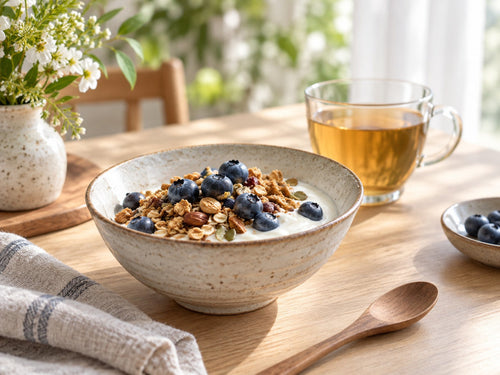
yogurt + fruit
natto + vegetables
miso soup + mushrooms or seaweed
5. You Do Not Have to Eat the Same Thing Every Day
Health routines can sometimes make people feel that consistency means repeating exactly the same food every day.
But eating can be more flexible than that.
Yogurt today.
Natto tomorrow.
Miso soup another day.
That variety is perfectly fine.
In fact, when looking at your diet as a whole, increasing food variety can be a useful goal.
Rather than deciding “I must eat this every day,” aim to include a range of foods in a way that feels manageable.
6. Morning or Evening—Which Is Better?
People often ask whether foods or supplements containing lactic acid bacteria are better in the morning or at night.
There is no single optimal time that applies to every type of lactic acid bacteria.
For foods, choose a time that fits your regular eating pattern—breakfast, lunch, or dinner.
For supplements, first follow the suggested intake and directions on the product label.
Rather than focusing only on the clock, also consider whether the routine is easy enough for you to remember and maintain.
7. What to Check When Choosing a Supplement
If you choose a supplement containing lactic acid bacteria, do not judge it by the largest number printed on the front of the package.
Useful points to check include:
- type of lactic acid bacteria
- strain
- amount included
- suggested daily intake
- other ingredients
- storage instructions
- quality control
- how easy it is to continue using
Some products combine multiple strains, while others focus on a particular strain.
Neither approach is automatically superior.
Look at the product as a whole and consider whether it fits your diet and your reason for using it.
8. Review More Than Your Diet
It is easy to focus only on foods and supplements when thinking about gut health.
But everyday habits such as:
sleep
movement
hydration
daily rhythm
matter too.
If you sit for long periods, try adding a little more walking.
If late nights have become routine, consider whether you can improve your sleep schedule.
Gut health is best viewed as one part of your overall lifestyle, not as a food-only issue.
9. The Key to Consistency Is Not Overdoing It
When starting a new health habit, it is easy to think:
I have to do this every single day.
I cannot miss once.
But some days are busy.
You travel.
You eat out more than usual.
Missing one day does not mean you need to give up completely.
A sustainable health routine is less about being perfect and more about being able to return to it without stress.
Find a way of continuing that fits your actual life.
10. Summary
There are many types and strains of lactic acid bacteria, and their characteristics differ across foods and products.
So rather than assuming there is one food you need every day, look at the bigger picture:
fermented foods
dietary fiber
food variety
sleep, movement, and hydration
If you include lactic acid bacteria in your routine, choose a method that feels realistic and sustainable for you.
ELVITA JOURNAL will continue to share clear, practical information about lactic acid bacteria and everyday gut health.
Important Note
※This article provides general information about health, nutrition, and lifestyle habits. It does not guarantee the effects or benefits of any specific product or ingredient.
※It is not intended to diagnose, treat, or prevent disease.

0 comments